how to draw 3d autocad 2014
Bones 3D and Surface Modelling
Introduction
Although AutoCAD has a number of commands for creating special 3D objects, a lot can be accomplished by changing the properties of basic 2D objects like polylines. Most 2d objects can be given a thickness using the thickness selection in the Properties (DDCHPROP) command. Although objects with a thickness tin can be said to be extruded, this should non be confused with the EXTRUDE command which creates solid extrusions; giving an object thickness produces a surface extrusion. All objects tin be given an elevation by moving them in the Z direction using the MOVE command. With a combination of the Motion and Properties commands you can quickly create uncomplicated 3D drawings.
Using this tutorial yous will larn how to requite objects a thickness, how to move them vertically, how to view your 3D creations and how to use the 3DFACE and SHADE commands.
The DDVPOINT Command
You tin can use this command to go an axonometric view of your drawing.
There are a number of ways to get an axonometric view of your AutoCAD drawing only the DDVPOINT control is probably the easiest and quickest to use. It is, nonetheless, cached 2 layers deep in the pull-down bill of fare so it's often quicker just to type it at the keyboard, since there is no toolbar button. As you probably recognise from the control proper name information technology is a dialogue box driven control. The Viewpoint Presets dialogue box is illustrated on the correct. Equally yous tin can encounter, yous define a view past specifying two angles. The kickoff angle is the rotation from the 10 centrality (the horizontal angle). The second is the angle from the XY airplane (the vertical angle). Using the dialogue box you can specify an bending either by picking on the ii dials or past entering an angle into each of the 2 angle edit boxes. You lot can even wait at your drawing from underneath by specifying a negative vertical bending. For nearly purposes a horizontal angle forth 1 of the diagonals, 45, 135, 225 and 315 and a vertical angle of 30 give the best results.
You can return to a program view of your drawing by using the PLAN command. To practice this, just enter "Program" at the command prompt and and so  to accept the "Electric current UCS" default. You can also render to any previous view by using the Zoom Previous command choice, Z P at the keyboard or
  from the Standard toolbar.
Top of folio
The Properties Control
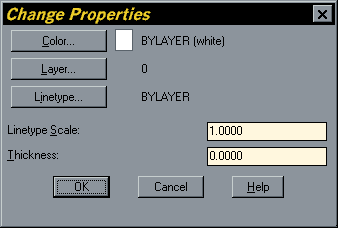
You can employ the DDCHPROP command to modify the colour, layer, linetype, linetype calibration and thickness of any unmarried or multiple object selection. The DDMODIFY command gives all of these change options in improver to those which are specific to the object blazon. DDMODIFY is always used by AutoCAD every bit a default for unmarried object selections when the Backdrop control is selected from the toolbar or from the pull-down menu.
Command Sequence
Command: DDCHPROP
Select objects: (pick one or more objects)
Select objects:
When you accept selected the objects, the Change Properties dialogue box appears. To change the thickness, just enter a value (in drawing units) in the Thickness edit box. When you click the "OK" button your objects will be extruded by the amount specified.
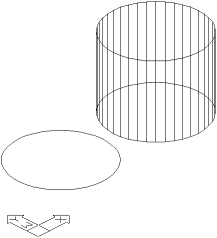
The illustration (correct) shows the result of applying a thickness to a circle. A circumvolve with no thickness is shown on the left and a circle with thickness on the correct.
Finer a circle with thickness becomes a cylinder. You can tell by the orientation of the UCS icon in this illustration that this is an axonometric view (see "The DDVPOINT Control" to a higher place for details).
Moving in the Z Direction
By at present y'all should be quite used to using the Move command but upwardly until now you've only been moving 2nd objects in the XY Airplane. Movement tin simply every bit easily be used to motion a drawing object vertically, perpendicular to the XY Plane. You can do this past using XY and Z co-ordinates or past picking points in 3D space.
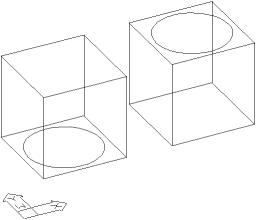 In the illustration on the left a circle has been moved from the base plane of a cube to the elevation confront of a cube. This is done past using the MOVE command ( from the pull-down or
  from the Modify toolbar). Just start the MOVE command, select the circle, pick one of the lower corners of the cube as the base point (use the end betoken Osnap!) and then option the corresponding top corner as the second betoken, once more using the end point Osnap. If you look at the circle in plan there appears to be no difference in it'south position because information technology has not been moved in the XY aeroplane but perpendicular to it. You lot can apply the same principle to motility any drawing entity. Bear in mind that you must always use an Osnap when you are picking points in 3D space. If yous practise not, the picked point volition e'er be on the base plane, which doesn't make any sense. One of the problems with this is that you may non realise your mistake until you change your view position considering in the current view the objects will appear to take been moved usually. It'due south a good idea to keep switching your view point as a check.
In the to a higher place example the motion was fairly piece of cake because we had a cube to use equally a guide. Very oftentimes you will need to move an object vertically without any guide. In such a instance you should use co-ordinates. For example, if the cube in the illustration higher up was 40 cartoon units high and so I could move the circumvolve using the following command sequence.
Command Sequence
Command: MOVE
Select objects: (select the circle)
Select objects:
Base betoken or displacement: 0,0,0
Second signal of displacement: 0,0,40
Notice that I utilize the UCS origin indicate equally a base of operations point, that'south considering information technology's standard practise just in principle information technology could be whatsoever indicate in space. The most important affair is that the X and Y co-ordinates remain the aforementioned (because we do not want to move in the XY Plane) and the Z co-ordinate must increase by the distance you desire to motion up. Using co-ordinate 25,43,xvi as the base point and 25,43,56 as the second betoken would have resulted in exactly the same move. To move downward you lot just demand to specify a negative Z co-ordinate. For example to move the circle down past 40 units the second point according would be 0,0,-40.
Height of folio
The 3D Face Control
 The 3D Face command is used to draw 3D surfaces with three or four edges.
Control Sequence
Command: 3DFACE
Outset Point: (pick betoken)
Second Point: (pick point)
Third Point: (option signal)
Fourth Bespeak: (pick betoken or for only iii edges)
Third Point: (showtime another 3D Face or to finish)
Why do I need a 3D Face?
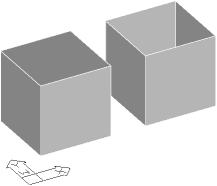
The reason is that when you lot give an entity similar a rectangle a thickness information technology is given solid sides in the direction of the extrusion but information technology is left open ended like a tube. To add a height and a bottom to a box you must use 3D Faces. In the illustration on the right, two boxes take been shaded using the Shade control, SHADE from the keyboard, from the pull-down or  from the Render toolbar. Run across SHADE for a description of the Shade control options. The box on the right is a rectangle which has been given a thickness. As you can run into, it does not have a elevation. A 3D Face has been added to the acme of the box on the left which gives the event of a solid surface when shaded.
When you use the Shade control, don't forget to use the Regen command to get back to the wireline cartoon. AutoCAD does not allow you to pick points on a shaded drawing.
For complicated shapes you may need to utilize a number of 3D Faces to fill a surface. Fortunately, extruded circles are automatically given a solid acme and bottom so you don't demand any 3D Faces. If you lot do demand to use a complex of faces to fill a surface there is a style to hibernate the join lines between faces. If you lot type "I" and before the first pick bespeak of any border, that edge will be made invisible. If y'all are careful you tin easily fill a complicated surface with many 3D Faces which will simply announced as a single continuous surface. If y'all need to create a very complex surface it may be better to employ the EXTRUDE command which creates solid extrusions i.east. they already accept elevation and bottom surfaces.
Peak of folio
An Practice
The exercise below is designed and then that you can practice all of the new commands and techniques outlined above. Information technology is a simple table which is composed of 9 primary elements, 4 legs, four runway, and a meridian. These elements are all constructed using the Rectangle command, RECTANG from the keyboard or from the pull-downwardly card. Think, in that location is nothing special near rectangles, they are but four sided closed polylines, and then if yous prefer using the PLINE control, then feel gratis.
These rectangles will exist given a thickness using the Properties command and an tiptop using the MOVE command. Some 3D Faces are used for the finishing touches using the 3DFACE command.
Top of folio
Cartoon the Table
Step 1
First of all draw the table plan using the dimensions on the illustration and inset detail below. All dimensions are in millimetres. The plan is equanimous of nine rectangles. You may need to use other commands like Line  and Offset
  to construct the rectangles. Alternatively you can work out the rectangle co-ordinates and construct them manually. Recollect to utilize the Copy
  and/or Mirror
  commands to indistinguishable identical objects. For example, it'south really only necessary to draw one leg since they are all the same.
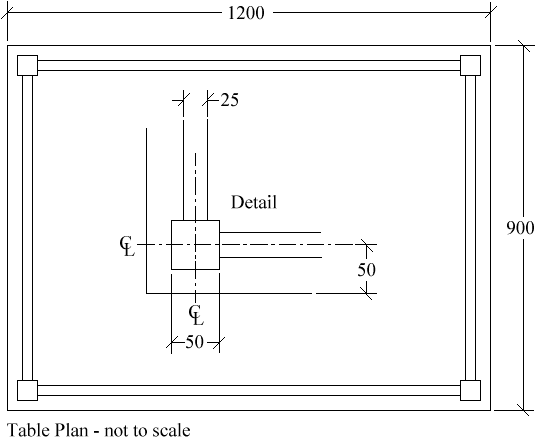
Footstep two
Adjacent, using the Properties  command, select the 4 table legs and give them a thickness of 700. Using the Properties command a 2nd time, select the four tabular array rail and requite them a thickness of 100. Move the runway vertically through 600 with the Motion command using a co-ordinate value of 0,0,0 for the base of operations point and 0,0,600 for the second signal. Finally use the Backdrop command a tertiary fourth dimension to requite the table top a thickness of 40 and use Motility again to give the height an top of 700. Now wait at what you lot take created using the DDVPOINT command, from the pull-downward or DDVPOINT at the keyboard. Use the SHADE control to run across the solid upshot, from the pull-down or SHADE at the keyboard.
Footstep 3
As you will have noticed, your table does not yet have a solid top. You can achieve this using 3D Face. You can start the 3D Confront command from the pull-downward, , from the Render toolbar,  or from the keyboard, 3DFACE. 3D Faces are divers past picking the iv points of a rectangle in either a clockwise or anticlockwise direction. Start the 3D Face command and using the endpoint Osnap, select the 4 upper corners of the table peak. Use the Shade command again to come across the issue. You tin use more than 3D Faces to consummate the model. Past looking at the table from various angles you will notice that the underside of the rails, the underside of the legs and the underside of the table summit all need 3D Faces in order to create a completely solid model.
Now that yous have completed your model, experiment with the Shade command and the various shade edge settings (see "Tips and Tricks" below).
Step 4
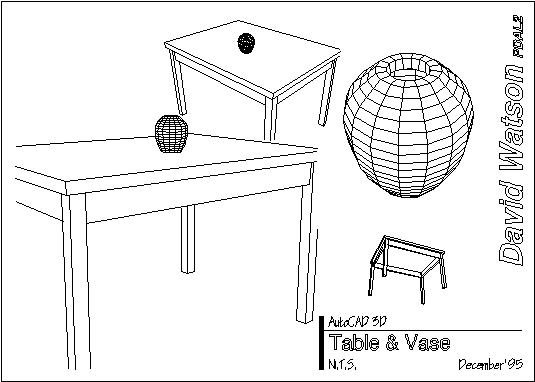
To finish your drawing, set tilemode to 0, create an A3 drawing sheet and insert some tiled viewports, see thePaper Space exercise for details. Your drawing should end up looking something like the i beneath. The vase was created using the REVSURF command, encounter REVSURF for details.
Top of page
3D Objects
In addition to the uncomplicated 3D objects you tin create by giving objects thickness and adding 3D Faces, AutoCAD provides a number of fix made 3D objects. These objects can exist chosen from the 3D Objects dialogue box. Every bit y'all tin can encounter from the illustration of the dialogue box below, you lot can create very uncomplicated objects like a box and complex ones like the torus.
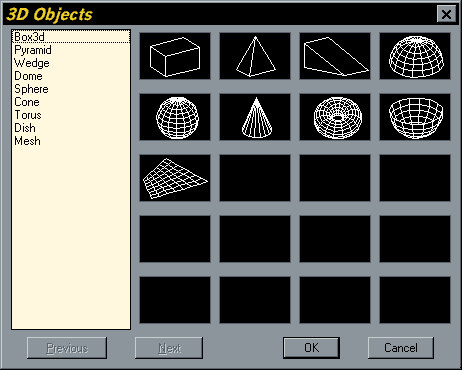
You must invoke the 3D objects dialogue box from the pull-downward menu, equally there is no keyboard equivalent. Alternatively you lot can select individual 3D Object commands from the Surfaces toolbar. Each 3D Object requires dissimilar input from the user but the command line is quite explicit so yous shouldn't take any problems.
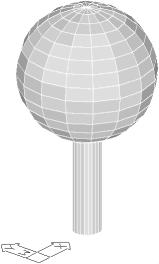 One of the most useful objects is the Sphere. In the illustration on the right a 3D tree has been created using a circle with thickness as the torso and a sphere equally the canopy. One thing to bear in mind when creating spheres is that the eye of the sphere volition be on the basis plane. Therefore, half of the sphere is below basis level and half above. If you want the sphere to sit on the footing plane, all yous have to practice is move it upwardly through a distance which is the same equally it's radius.
Another consideration when creating spheres and some of the other shapes is the number of segments to employ. It is very tempting to use a lot and create a polish shape but this does have lots of cartoon retention so go advisedly. The default value (16) is usually adequate for well-nigh purposes.
Command Sequence
Invoke the dialogue box from the pull-down (), option the sphere icon and then the "OK" push button or option  from the Surfaces toolbar.
Center of sphere: (pick point)
Diameter/<radius>: (pick point or enter value)
Number of longitudinal segments<16>: (enter number or)
Number of latitudinal segments<16>: (enter number or)
Your Sphere is fatigued.
Top of page
Tips & Tricks
- If y'all would like to try creating the vase as shown in the tabular array drawing. Y'all will need to know a little bit about UCS, User Co-ordinate Systems (run across UCS) and how the Revolved Surface control works (see the 3D Tree exercise for details).
- You tin can change the shaded event that the Shade control gives to your drawing using the SHADEDGE variable. To change the shade border variable simply enter SHADEDGE at the keyboard and enter a value between 0 and 3.
SHADEDGE = 0 gives a shaded colour surface with no lines.
SHADEDGE = 1 gives a shaded colour surface with lines. This tends to give the best overall results.
SHADEDGE = 2 gives a background color surface which gives a like effect to the Hide command.
SHADEDGE = 3 gives a cake color surface, this is the AutoCAD default. See SHADE for a fuller description of the SHADEDGE variable. - Ever utilise Osnaps when picking in 3D.
- Utilize the Shade control regularly to continue runway of your drawing. In wireline it's impossible to tell if a surface has a 3D Face or non, so you'll need to use Shade to check.
- You can forcefulness invisible 3D Face up edges to display in wireline using the SPLFRAME variable. If SPLFRAME = 0 all invisible edges remain hidden. If it is set to one invisible edges will exist displayed. This can be extremely useful because it is impossible to select a 3D Confront which has no visible edges. The simply mode to select such a 3D Face is to gear up SPLFRAME to 1 first.
Summit of folio
Donate to CADTutor
If you constitute this tutorial useful, y'all might similar to consider making a donation. All content on this site is provided free of charge and we promise to keep it that manner. Nevertheless, running a site like CADTutor does price coin and you can help to ameliorate the service and to guarantee its future by donating a small amount. We guess that you probably wouldn't miss $5.00 but information technology would make all the difference to us.
Source: https://www.cadtutor.net/tutorials/autocad/basic-3d.php

Posting Komentar untuk "how to draw 3d autocad 2014"